


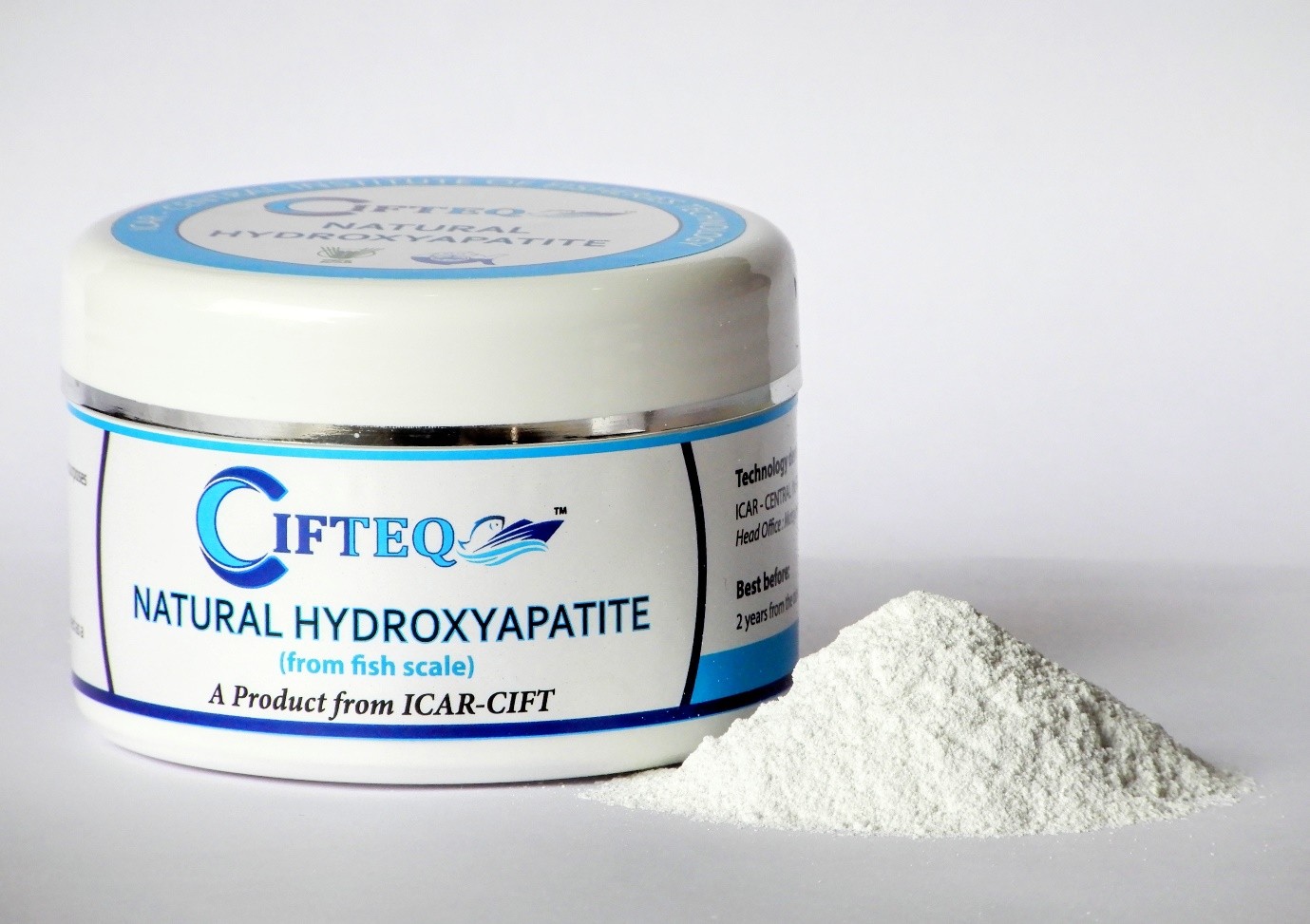
HYDROXYAPATITE fromFish scale
Hydroxyapatite (HAP) is seen embedded in the organic matrix of collagen, normally associated with the natural materials such as bone and fish scale. These mineral crystals are responsible for the bone hardness, strength and rigidity, and collagen fibres provide flexibility. It is one of the few materials, classified as a bioactive natural material that supports bone in growth and osseo- integration; hence, popularly known as the 'second generation calcium supplement'. Hydroxyapatite and calcium phosphate based biomaterials have attracted considerable interest in the field of tissue engineering. Among the main areas of application of HAP, the most promising areas are orthopaedics and orthodontics, where bone tissue has to be replaced, partially or totally. The studies indicate that the total global biomaterials market is expected to be worth US$ 58.1 billion by 2014, growing at a Compound Annual Growth Rate (CAGR) of 15 % from 2009 to 2014. Interestingly, Asian market size is estimated to increase at the highest CAGR of 18.2% in the same period. The manufacture of biomaterials and devices depends on both cost effective production technology and the availability of cheaper raw materials. Fish processing waste offers a rich source of this highly valuable mineral composite. The content of hydroxyapatite in fish scale and bone ranges from 40 to 45% (w/w). Hydroxyapatite from such natural sources is biologically safe and is economical as it is prepared from cheaper raw materials. Worldwide, fish industry waste is considered as an important pollutant having serious impact on the environment. The Fish Processing Division of CIFT has developed and standardized a novel low cost method for preparing hydroxyapatite crystals from fish processing waste which otherwise cause serious environmental problems
Hydroxyapatite as bio-ceramic material
Bone is comprised of three basic building blocks - collagen fibrils, mineral plates, and a matrix of unmineralized, non-fibrillar organic material, mostly made of proteoglycans and glycoproteins. Hydroxyapatite compose 67% of the weight of human bone. HAP is identified as an ideal raw material for the development of artificial bone implants and bone filling material. The idea is to create physicochemical links, between ceramic and surrounding bone tissue, promoting their integration and growth of new tissue. Over time they are partially resorbed and replaced by natural bone. The major challenge in the development of a bio-ceramic material is to create a totally non-immunogenic material that is as similar as possible to the natural bone tissue, so as to get maximum compatibility with the host body. The ideal bio-ceramic material must be easily fabricated and preserved, biocompatible and biodegradable. Since, hydroxyapatite is the basic bone mineral, it is totally biocompatible and nontoxic and becomes an integral part of living bone tissue. However, the synthetic form of hydroxyapatite has been shown to be chemically and crystallographically similar, but not identical, to naturally occurring HAP. These materials should have high porosity (the order of hundreds of microns) to allow the development of bone within and across them. The Apatone is multiporous and have high degree of interconnectivity. The high porosity of HAP permits the bone tissue growth into the pores of the implant once inserted.
Artificial tooth enamel Dental caries represents the most prevalent chronic disease in both children and adults. Roughly 97% of tooth enamel and 70% of dentin comprises hydroxyapatite. At the initial stage of dental caries, bacteria cause the damage of enamel which is scarcely being self-
repaired by living organisms. Therefore, the remineralization of enamel minerals by using synthetic apatite is always suggested in dental research. The native structure of enamel is too complex to be remodelled. The synthesized apatite crystallites often have different dimensions, morphologies, and orientations from the natural ones, which result in poor adhesion and mechanical strength during the restoration. Additionally it has been documented to possess antibacterial potentials and hence is a potential candidate for pulp capping and cavity lining. Being a high value pharma product extraction of hydroxyapatite from fish scales offer exiting scope for the utilisation of fish waste.

Page Last Updated on 2026-09-04
Visitors Count :

All rights reserved © Central Institute of Fisheries Technology (CIFT)
Website Powered by Cloud Business Pages from INI Technologies Pvt Ltd, India